




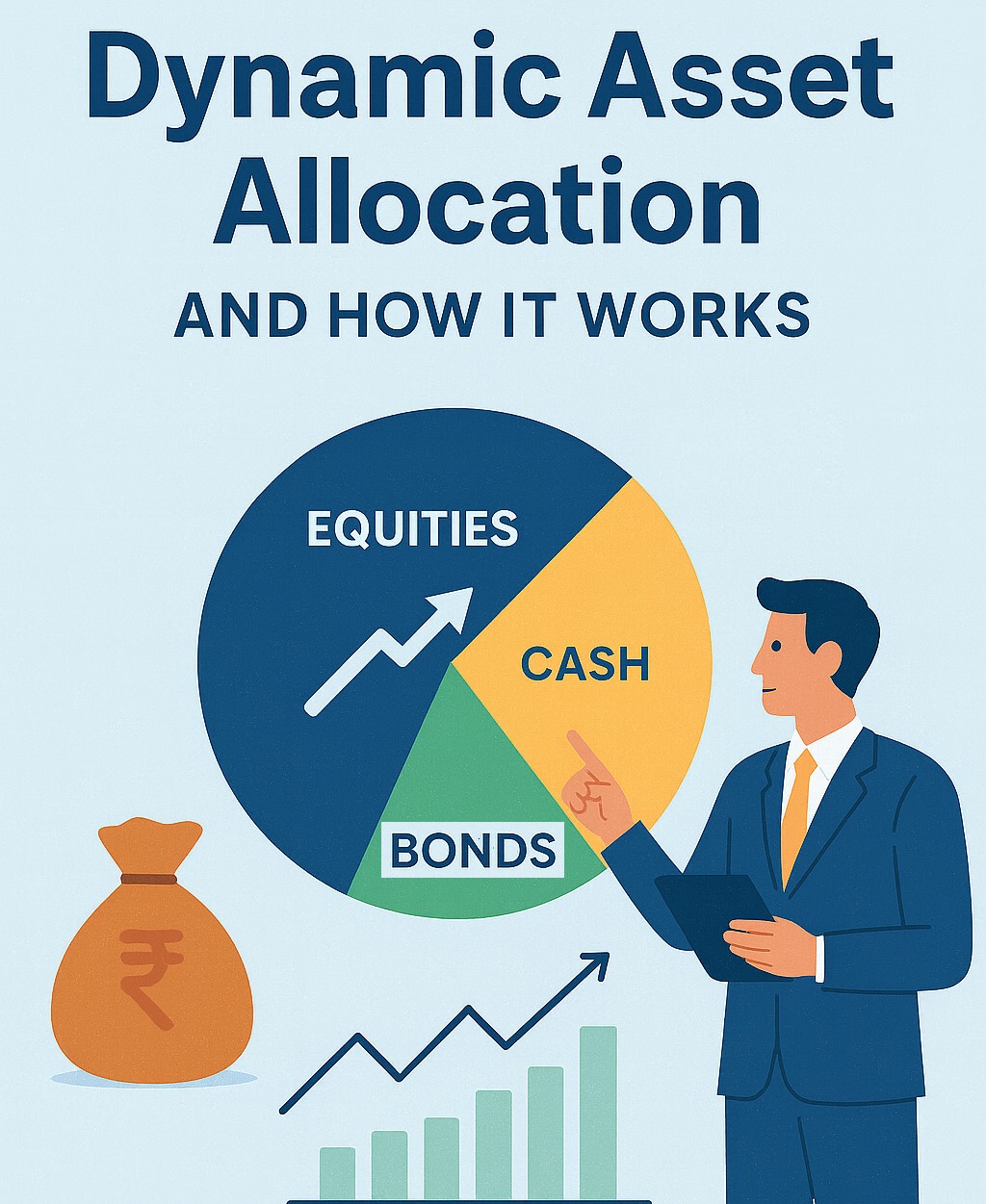
One
of the most important decisions in investing isn't just what you invest in, but
how you divide your investments. That's where asset allocation comes in. It's
the process of spreading your money across different asset classes like equity,
debt, and others to manage risk and aim for better returns.
But
markets don't stand still. Economic cycles shift, valuations change, and
investor sentiment evolves. In such an environment, simply following a fixed
allocation might not be enough. This is where a more flexible approach, offered
by Dynamic Asset Allocation, can help investors stay better aligned with
changing market realities.
What
is Dynamic Asset Allocation
Dynamic
Asset Allocation (DAA) is a method by which the portfolio's allocation between
equity and debt is adjusted based on market conditions.
Unlike fixed allocation strategies that follow a set ratio, DAA provides
flexibility by adjusting the allocation over time to respond to changing market
trends and asset valuations. One of the most common approaches within DAA is to
increase exposure to an asset class when its valuations become more attractive,
typically by investing more when valuations decline.
A commonly used input in DAA strategies is market valuation, measured using
different valuation metrics like the Price-to-Earnings (P/E) ratio, the
Price-to-Book Value (P/B) ratio, and the Dividend Yield. Alongside this,
indicators like government bond yields help determine how attractive equity is
relative to debt.
How
Does Dynamic Allocation Work?
There
isn't a one-size-fits-all DAA strategy; the shift in allocation can be based on
different models. Some strategies increase equity exposure when markets are
down (counter-cyclical), some ride ongoing trends (pro-cyclical), and others
blend both approaches.
To better understand how Dynamic Asset Allocation works in practice, let's look
at a simple hypothetical example:
|
Scenario |
Date |
Nifty 500 P/E |
10 Yr G-Sec Yield |
Equity Allocation |
Nifty 500 Next 3-Month Return |
Nifty 500 Next 6-Month Return |
|
When
equity valuations were most attractive / lowest P/E |
2009-03-10 |
8.6 |
6.51 |
100.00% |
90.12% |
100.98% |
|
When
equity valuations were least attractive / most expensive |
2021-02-15 |
41.05 |
6.08 |
41.17% |
-1.08% |
12.12% |
|
When
the Bond yields were maximum |
2008-07-11 |
14.61 |
9.46 |
55.88% |
-21.98% |
-30.60% |
|
When
the Bond yields were minimum |
2009-01-05 |
10.29 |
5.05 |
100.00% |
0.12% |
47.51% |
Source:
CMIE, NSE, Internal Research. Data is for the period 13th August 2007 to 31st
May 2025. The table illustrates a hypothetical Dynamic Asset Allocation model
based on the market valuation and interest rates. It shows how equity exposure
is adjusted across different market conditions using valuation (Nifty 500 P/E
in this case) and interest rate (10-Year G-Sec Yield here) signals. The
figures/projections are for illustrative purposes only. The situations/results
may or may not materialise in the future. Past performance may or may not be
sustained in future & is not a guarantee of any future returns.
Benefits of Dynamic Asset Allocation
DAA
brings structure and flexibility to portfolio management, helping investors
stay balanced through market ups and downs:
·
Helps manage
risk: By reducing equity
exposure during volatile or overvalued markets, DAA aims to cushion the
downside during market corrections.
·
Adapts to
changing conditions: Unlike
static strategies, it adjusts based on current data, allowing the portfolio to
stay relevant to the market environment.
·
Reduces
emotional investing: A rule-based or
model-driven DAA approach can prevent impulsive decisions driven by fear
or biases.
· Better risk-adjusted return potential: By actively shifting allocations, DAA can take advantage of opportunities across market cycles and offer better risk-adjusted return potential.
Despite its advantages, DAA requires careful execution and commitment:
·
Depends on
execution quality: The success of DAA depends heavily on the model, rules,
or fund manager implementing the shifts.
·
Requires
discipline and patience: Investors must stay committed to the strategy,
even when short-term performance may not match that of traditional approaches.
·
Higher costs
and turnover: Frequent reallocations may lead to higher transaction costs
or tax implications, especially in actively managed DAA strategies.
What are Dynamic Asset Allocation Funds?
Dynamic Asset Allocation Funds, commonly known as
Balanced Advantage Funds, are a sub-category under Hybrid Mutual Funds. These
funds follow the dynamic asset allocation (DAA) strategy with the goal of
managing flexibility while participating in growth opportunities.
Over the years, this category has gained significant traction among investors
for its ability to adapt across market cycles with the number of schemes in
this category increased from 20 in May 2019 to 35 by May 2025, and the assets
under management (AUM) more than tripled, growing from Rs.94,997 crore to
Rs.2.99 lakh crore during the same period (Source: AMFI).
FAQs
1) What is the difference
between strategic asset allocation and dynamic asset allocation?
Strategic asset allocation follows a long-term target mix of assets and sticks
to it, only rebalancing periodically. Dynamic asset allocation, on the other
hand, adjusts the mix more frequently based on current market conditions.
2) Are dynamic asset allocation funds suitable for SIPs?
Yes, they are well-suited for SIPs as they adjust to market conditions and
offer smoother returns over time, making them useful for long-term wealth
creation.
3) What is the difference between static and dynamic asset allocation?
Static allocation keeps a fixed equity-debt ratio, regardless of market
changes. Dynamic allocation shifts the mix over time in response to market
trends and opportunities
The information contained herein does not
constitute; and should not be construed as investment advice or a
recommendation to buy; sell; or otherwise transact in any security or
investment product or an invitation; offer or solicitation to engage in any investment
activity. It is strongly recommended that you seek professional investment
advice before taking any investment decision. Any investment decision that you
take should be based on an assessment of your risks in consultation with your
investment advisor.
To the extent that any information is regarding the
past performance of securities or investment products; please note that such
information is not a reliable indicator of future performance and should not be
relied upon as a basis for investment decision. Past performance does not
guarantee future performance and the value of investments and income from them
can fall as well as rise. No investment strategy is without risk and markets
influence investment performance. Investment markets and conditions can change
rapidly; and investors may not get back the amount originally invested and may
lose all of their investment
Prashanth Jogimutt (ARN 165858) AMFI Registered
Mutual Fund Distributor
Mutual Fund Investment are subject to market risks;
read all scheme related documents carefully before investing.
#jogimutt #jogimuttenterprisesllp
#investwithjogimutt #mfd #mfdindia #mfdbangalore #finance #money #insurance
#terminsurance #healthinsurance #assetinsurance #mutualfunds #SIP #SWP
#retirement #mutualfunddistributor #MutualFunds #SIP #SmartInvesting #PersonalFinance
#BangaloreInvestors #BangaloreFinance #BangaloreMutualFunds
#CertifiedMutualFundDistributor #MutualFundDistributorIndia
#MutualFundDistributorBangalore #FinanceWithJogimutt #InvestWithConfidence
#PrashanthJogimutt #followers #viral






 Call Us Now
  Address
 Email Us